
Input系统:ANR原理分析
转自:http://www.qingpingshan.com/m/view.php?aid=191258
基于Android 6.0源码, 分析Input事件发生ANR的原理
一. ANR概述
当input事件处理得慢就会触发ANR,那ANR内部原理是什么,哪些场景会产生ANR呢。 “工欲善其事必先利其器”,为了理解input ANR原理,前面几篇文章疏通了整个input框架的处理流程,都是为了这篇文章而做铺垫。在正式开始分析ANR触发原理以及触发场景之前,先来回顾一下input流程。
- Input系统—启动篇:Input系统也是伴随着system_server进程启动过程而启动。
- Input系统—InputReader线程 :通过EventHub从/dev/input节点获取事件,转换成EventEntry事件加入到InputDispatcher的mInboundQueue。
- Input系统—InputDispatcher线程 :从mInboundQueue队列取出事件,转换成DispatchEntry事件加入到connection的outboundQueue队列。再然后开始处理分发事件,取出outbound队列,放入waitQueue.
- Input系统—UI线程:Activity的onResume执行完便会向WMS注册窗口信息,并建立socket pair用于跨进程通信;
- Input系统—进程交互:系统进程的”InputDispatcher”线程和应用进程的UI主线程通过socket pair进行交互;
有了以上基础,再来从ANR视角看看Input系统。
1.1 InputReader
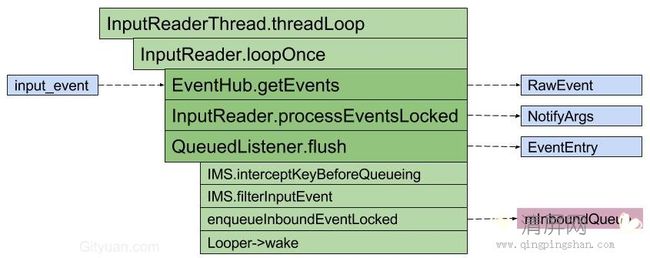
InputReader的主要工作分两部分:
- 调用EventHub的getEvents()读取节点/dev/input的input_event结构体转换成RawEvent结构体,RawEvent根据不同InputMapper来转换成相应的EventEntry,比如按键事件则对应KeyEntry,触摸事件则对应MotionEntry。
- 转换结果:inut_event -> EventEntry;
- 将事件添加到mInboundQueue队列尾部,加入该队列前有以下两个过滤:
- IMS.interceptKeyBeforeQueueing:事件分发前可增加业务逻辑;
- IMS.filterInputEvent:可拦截事件,当返回值为false的事件都直接拦截,没有机会加入mInboundQueue队列,不会再往下分发;否则进入下一步;
- enqueueInboundEventLocked:该事件放入mInboundQueue队列尾部;
- mLooper->wake:并根据情况来唤醒InputDispatcher线程.
1.2 InputDispatcher

- dispatchOnceInnerLocked(): 从InputDispatcher的
mInboundQueue队列,取出事件EventEntry。另外该方法开始执行的时间点(currentTime)便是后续事件dispatchEntry的分发时间(deliveryTime) - dispatchKeyLocked():满足一定条件时会添加命令doInterceptKeyBeforeDispatchingLockedInterruptible;
- enqueueDispatchEntryLocked():生成事件DispatchEntry并加入connection的
outbound队列 - startDispatchCycleLocked():从outboundQueue中取出事件DispatchEntry, 重新放入connection的
waitQueue队列; - runCommandsLockedInterruptible():通过循环遍历地方式,依次处理mCommandQueue队列中的所有命令。而mCommandQueue队列中的命令是通过postCommandLocked()方式向该队列添加的。ANR回调命令便是在这个时机执行。
- handleTargetsNotReadyLocked(): 该过程会判断是否等待超过5s来决定是否调用onANRLocked().
1.3 UI线程

- “InputDispatcher”线程监听socket服务端,收到消息后回调InputDispatcher.handleReceiveCallback();
- UI主线程监听socket客户端,收到消息后回调NativeInputEventReceiver.handleEvent().
对于ANR的触发主要是在InputDispatcher过程,下面再从ANR的角度来说一说ANR触发过程。
二. ANR触发机制
2.1 dispatchOnceInnerLocked
void InputDispatcher::dispatchOnceInnerLocked(nsecs_t* nextWakeupTime) {
    nsecs_t currentTime = now(); //当前时间

    if (!mDispatchEnabled) { //默认值为false
        resetKeyRepeatLocked(); //重置操作
    }
    if (mDispatchFrozen) { //默认值为false
        return; //当分发被冻结,则不再处理超时和分发事件的工作,直接返回
    }

    //优化app切换延迟,当切换超时,则抢占分发,丢弃其他所有即将要处理的事件。
    bool isAppSwitchDue = mAppSwitchDueTime <= currentTime;
    ...

    if (!mPendingEvent) {
        if (mInboundQueue.isEmpty()) {
            if (!mPendingEvent) {
                return; //没有事件需要处理,则直接返回
            }
        } else {
            //从mInboundQueue取出头部的事件
            mPendingEvent = mInboundQueue.dequeueAtHead();
        }
        ...
        resetANRTimeoutsLocked(); //重置ANR信息[见小节2.1.1]
    }

    bool done = false;
    DropReason dropReason = DROP_REASON_NOT_DROPPED;
    if (!(mPendingEvent->policyFlags & POLICY_FLAG_PASS_TO_USER)) {
        dropReason = DROP_REASON_POLICY;
    } else if (!mDispatchEnabled) {
        dropReason = DROP_REASON_DISABLED;
    }
    ...

    switch (mPendingEvent->type) {
      case EventEntry::TYPE_KEY: {
          KeyEntry* typedEntry = static_cast(mPendingEvent);
          if (isAppSwitchDue) {
              if (isAppSwitchKeyEventLocked(typedEntry)) {
                  resetPendingAppSwitchLocked(true);
                  isAppSwitchDue = false;
              } else if (dropReason == DROP_REASON_NOT_DROPPED) {
                  dropReason = DROP_REASON_APP_SWITCH;
              }
          }
          if (dropReason == DROP_REASON_NOT_DROPPED
                  && isStaleEventLocked(currentTime, typedEntry)) {
              dropReason = DROP_REASON_STALE;
          }
          if (dropReason == DROP_REASON_NOT_DROPPED && mNextUnblockedEvent) {
              dropReason = DROP_REASON_BLOCKED;
          }
          // 分发按键事件[见小节2.2]
          done = dispatchKeyLocked(currentTime, typedEntry, &dropReason, nextWakeupTime);
          break;
      }
      ...
    }
    ...

    //分发操作完成,则进入该分支
    if (done) {
        if (dropReason != DROP_REASON_NOT_DROPPED) {
            //[见小节2.1.2]
            dropInboundEventLocked(mPendingEvent, dropReason);
        }
        mLastDropReason = dropReason;
        releasePendingEventLocked(); //释放pending事件
        *nextWakeupTime = LONG_LONG_MIN; //强制立刻执行轮询
    }
}
在enqueueInboundEventLocked()的过程中已设置mAppSwitchDueTime等于eventTime加上500ms:
mAppSwitchDueTime = keyEntry->eventTime + APP_SWITCH_TIMEOUT;
该方法主要功能:
- mDispatchFrozen用于决定是否冻结事件分发工作不再往下执行;
- 当事件分发的时间点距离该事件加入mInboundQueue的时间超过500ms,则认为app切换过期,即isAppSwitchDue=true;
- mInboundQueue不为空,则取出头部的事件,放入mPendingEvent变量;并重置ANR时间;
- 根据情况设置dropReason;
- 根据EventEntry的type类型分别处理,比如按键调用dispatchKeyLocked分发事件;
- 执行完成后,根据dropReason来决定是否丢失事件,以及释放当前事件;
接下来以按键为例来展开说明, 则进入[小节2.2] dispatchKeyLocked
2.1.1 resetANRTimeoutsLocked
void InputDispatcher::resetANRTimeoutsLocked() {
    // 重置等待超时cause和handle
    mInputTargetWaitCause = INPUT_TARGET_WAIT_CAUSE_NONE;
    mInputTargetWaitApplicationHandle.clear();
}
2.1.2 dropInboundEventLocked
void InputDispatcher::dropInboundEventLocked(EventEntry* entry, DropReason dropReason) {
    const char* reason;
    switch (dropReason) {
    case DROP_REASON_POLICY:
        reason = "inbound event was dropped because the policy consumed it";
        break;
    case DROP_REASON_DISABLED:
        if (mLastDropReason != DROP_REASON_DISABLED) {
            ALOGI("Dropped event because input dispatch is disabled.");
        }
        reason = "inbound event was dropped because input dispatch is disabled";
        break;
    case DROP_REASON_APP_SWITCH:
        ALOGI("Dropped event because of pending overdue app switch.");
        reason = "inbound event was dropped because of pending overdue app switch";
        break;
    case DROP_REASON_BLOCKED:
        ALOGI("Dropped event because the current application is not responding and the user "
                "has started interacting with a different application.");
        reason = "inbound event was dropped because the current application is not responding "
                "and the user has started interacting with a different application";
        break;
    case DROP_REASON_STALE:
        ALOGI("Dropped event because it is stale.");
        reason = "inbound event was dropped because it is stale";
        break;
    default:
        return;
    }

    switch (entry->type) {
    case EventEntry::TYPE_KEY: {
        CancelationOptions options(CancelationOptions::CANCEL_NON_POINTER_EVENTS, reason);
        synthesizeCancelationEventsForAllConnectionsLocked(options);
        break;
    }
    ...
    }
}
2.2 dispatchKeyLocked
bool InputDispatcher::dispatchKeyLocked(nsecs_t currentTime, KeyEntry* entry,
        DropReason* dropReason, nsecs_t* nextWakeupTime) {
    ...
    if (entry->interceptKeyResult ==    KeyEntry::INTERCEPT_KEY_RESULT_TRY_AGAIN_LATER) {
        //当前时间小于唤醒时间,则进入等待状态。
        if (currentTime < entry->interceptKeyWakeupTime) {
            if (entry->interceptKeyWakeupTime < *nextWakeupTime) {
                *nextWakeupTime = entry->interceptKeyWakeupTime;
            }
            return false; //直接返回
        }
        entry->interceptKeyResult = KeyEntry::INTERCEPT_KEY_RESULT_UNKNOWN;
        entry->interceptKeyWakeupTime = 0;
    }

    if (entry->interceptKeyResult == KeyEntry::INTERCEPT_KEY_RESULT_UNKNOWN) {
        //让policy有机会执行拦截操作
        if (entry->policyFlags & POLICY_FLAG_PASS_TO_USER) {
            CommandEntry* commandEntry = postCommandLocked(
                    & InputDispatcher::doInterceptKeyBeforeDispatchingLockedInterruptible);
            if (mFocusedWindowHandle != NULL) {
                commandEntry->inputWindowHandle = mFocusedWindowHandle;
            }
            commandEntry->keyEntry = entry;
            entry->refCount += 1;
            return false; //直接返回
        } else {
            entry->interceptKeyResult = KeyEntry::INTERCEPT_KEY_RESULT_CONTINUE;
        }
    } else if (entry->interceptKeyResult == KeyEntry::INTERCEPT_KEY_RESULT_SKIP) {
        if (*dropReason == DROP_REASON_NOT_DROPPED) {
            *dropReason = DROP_REASON_POLICY;
        }
    }

    //如果需要丢弃该事件,则执行清理操作
    if (*dropReason != DROP_REASON_NOT_DROPPED) {
        setInjectionResultLocked(entry, *dropReason == DROP_REASON_POLICY
                ? INPUT_EVENT_INJECTION_SUCCEEDED : INPUT_EVENT_INJECTION_FAILED);
        return true; //直接返回
    }

    Vector inputTargets;
    // 【见小节2.3】
    int32_t injectionResult = findFocusedWindowTargetsLocked(currentTime,
            entry, inputTargets, nextWakeupTime);
    if (injectionResult == INPUT_EVENT_INJECTION_PENDING) {
        return false; //直接返回
    }

    setInjectionResultLocked(entry, injectionResult);
    if (injectionResult != INPUT_EVENT_INJECTION_SUCCEEDED) {
        return true; //直接返回
    }
    addMonitoringTargetsLocked(inputTargets);

    //只有injectionResult是成功,才有机会执行分发事件【见小节2.5】
    dispatchEventLocked(currentTime, entry, inputTargets);
    return true;
}
在以下场景下,有可能无法分发事件:
- 当前时间小于唤醒时间(nextWakeupTime)的情况;
- policy需要提前拦截事件的情况;
- 需要drop事件的情况;
- 寻找聚焦窗口失败的情况;
如果成功跳过以上所有情况,则会进入执行事件分发的过程。
2.3 findFocusedWindowTargetsLocked
int32_t InputDispatcher::findFocusedWindowTargetsLocked(nsecs_t currentTime,
        const EventEntry* entry, Vector& inputTargets, nsecs_t* nextWakeupTime) {
    int32_t injectionResult;
    String8 reason;

    if (mFocusedWindowHandle == NULL) {
        if (mFocusedApplicationHandle != NULL) {
            //【见小节2.3.2】
            injectionResult = handleTargetsNotReadyLocked(currentTime, entry,
                    mFocusedApplicationHandle, NULL, nextWakeupTime,
                    "Waiting because no window has focus but there is a "
                    "focused application that may eventually add a window "
                    "when it finishes starting up.");
            goto Unresponsive;
        }

        ALOGI("Dropping event because there is no focused window or focused application.");
        injectionResult = INPUT_EVENT_INJECTION_FAILED;
        goto Failed;
    }

    //权限检查
    if (! checkInjectionPermission(mFocusedWindowHandle, entry->injectionState)) {
        injectionResult = INPUT_EVENT_INJECTION_PERMISSION_DENIED;
        goto Failed;
    }

    //检测窗口是否为更多的输入操作而准备就绪【见小节2.3.1】
    reason = checkWindowReadyForMoreInputLocked(currentTime,
            mFocusedWindowHandle, entry, "focused");
    if (!reason.isEmpty()) {
        //【见小节2.3.2】
        injectionResult = handleTargetsNotReadyLocked(currentTime, entry,
                mFocusedApplicationHandle, mFocusedWindowHandle, nextWakeupTime, reason.string());
        goto Unresponsive;
    }

    injectionResult = INPUT_EVENT_INJECTION_SUCCEEDED;
    //成功找到目标窗口,添加到目标窗口
    addWindowTargetLocked(mFocusedWindowHandle,
            InputTarget::FLAG_FOREGROUND | InputTarget::FLAG_DISPATCH_AS_IS, BitSet32(0),
            inputTargets);

Failed:
Unresponsive:
    //TODO: 统计等待时长信息,目前没有实现,这个方法还是很值得去改造
    nsecs_t timeSpentWaitingForApplication = getTimeSpentWaitingForApplicationLocked(currentTime);
    updateDispatchStatisticsLocked(currentTime, entry,
          injectionResult, timeSpentWaitingForApplication);
    return injectionResult;
}
寻找聚焦窗口失败的情况:
- 无窗口,无应用:Dropping event because there is no focused window or focused application.(这并不导致ANR的情况,因为没有机会调用handleTargetsNotReadyLocked)
- 无窗口, 有应用:Waiting because no window has focus but there is a focused application that may eventually add a window when it finishes starting up.
另外,还有更多多的失败场景见checkWindowReadyForMoreInputLocked的过程,如下:
2.3.1 checkWindowReadyForMoreInputLocked
String8 InputDispatcher::checkWindowReadyForMoreInputLocked(nsecs_t currentTime,
        const sp& windowHandle, const EventEntry* eventEntry,
        const char* targetType) {
    //当窗口暂停的情况,则保持等待
    if (windowHandle->getInfo()->paused) {
        return String8::format("Waiting because the %s window is paused.", targetType);
    }

    //当窗口连接未注册,则保持等待
    ssize_t connectionIndex = getConnectionIndexLocked(windowHandle->getInputChannel());
    if (connectionIndex < 0) {
        return String8::format("Waiting because the %s window's input channel is not "
                "registered with the input dispatcher.  The window may be in the process "
                "of being removed.", targetType);
    }

    //当窗口连接已死亡,则保持等待
    sp connection = mConnectionsByFd.valueAt(connectionIndex);
    if (connection->status != Connection::STATUS_NORMAL) {
        return String8::format("Waiting because the %s window's input connection is %s."
                "The window may be in the process of being removed.", targetType,
                connection->getStatusLabel());
    }

    // 当窗口连接已满,则保持等待
    if (connection->inputPublisherBlocked) {
        return String8::format("Waiting because the %s window's input channel is full.  "
                "Outbound queue length: %d.  Wait queue length: %d.",
                targetType, connection->outboundQueue.count(), connection->waitQueue.count());
    }

    //确保分发队列,并没有存储过多事件
    if (eventEntry->type == EventEntry::TYPE_KEY) {
        if (!connection->outboundQueue.isEmpty() || !connection->waitQueue.isEmpty()) {
            return String8::format("Waiting to send key event because the %s window has not "
                    "finished processing all of the input events that were previously "
                    "delivered to it.  Outbound queue length: %d.  Wait queue length: %d.",
                    targetType, connection->outboundQueue.count(), connection->waitQueue.count());
        }
    } else {
        if (!connection->waitQueue.isEmpty()
                && currentTime >= connection->waitQueue.head->deliveryTime
                        + STREAM_AHEAD_EVENT_TIMEOUT) {
            return String8::format("Waiting to send non-key event because the %s window has not "
                    "finished processing certain input events that were delivered to it over "
                    "%0.1fms ago.  Wait queue length: %d.  Wait queue head age: %0.1fms.",
                    targetType, STREAM_AHEAD_EVENT_TIMEOUT * 0.000001f,
                    connection->waitQueue.count(),
                    (currentTime - connection->waitQueue.head->deliveryTime) * 0.000001f);
        }
    }
    return String8::empty();
}
2.3.2 handleTargetsNotReadyLocked
int32_t InputDispatcher::handleTargetsNotReadyLocked(nsecs_t currentTime,
    const EventEntry* entry,
    const sp& applicationHandle,
    const sp& windowHandle,
    nsecs_t* nextWakeupTime, const char* reason) {
    if (applicationHandle == NULL && windowHandle == NULL) {
        if (mInputTargetWaitCause != INPUT_TARGET_WAIT_CAUSE_SYSTEM_NOT_READY) {
            mInputTargetWaitCause = INPUT_TARGET_WAIT_CAUSE_SYSTEM_NOT_READY;
            mInputTargetWaitStartTime = currentTime; //当前时间
            mInputTargetWaitTimeoutTime = LONG_LONG_MAX;
            mInputTargetWaitTimeoutExpired = false;
            mInputTargetWaitApplicationHandle.clear();
        }
    } else {
        if (mInputTargetWaitCause != INPUT_TARGET_WAIT_CAUSE_APPLICATION_NOT_READY) {
            nsecs_t timeout;
            if (windowHandle != NULL) {
                timeout = windowHandle->getDispatchingTimeout(DEFAULT_INPUT_DISPATCHING_TIMEOUT);
            } else if (applicationHandle != NULL) {
                timeout = applicationHandle->getDispatchingTimeout(DEFAULT_INPUT_DISPATCHING_TIMEOUT);
            } else {
                timeout = DEFAULT_INPUT_DISPATCHING_TIMEOUT; // 5s
            }

            mInputTargetWaitCause = INPUT_TARGET_WAIT_CAUSE_APPLICATION_NOT_READY;
            mInputTargetWaitStartTime = currentTime; //当前时间
            mInputTargetWaitTimeoutTime = currentTime + timeout;
            mInputTargetWaitTimeoutExpired = false;
            mInputTargetWaitApplicationHandle.clear();

            if (windowHandle != NULL) {
                mInputTargetWaitApplicationHandle = windowHandle->inputApplicationHandle;
            }
            if (mInputTargetWaitApplicationHandle == NULL && applicationHandle != NULL) {
                mInputTargetWaitApplicationHandle = applicationHandle;
            }
        }
    }

    if (mInputTargetWaitTimeoutExpired) {
        return INPUT_EVENT_INJECTION_TIMED_OUT; //等待超时已过期,则直接返回
    }

    //当超时5s则进入ANR流程
    if (currentTime >= mInputTargetWaitTimeoutTime) {
        onANRLocked(currentTime, applicationHandle, windowHandle,
                entry->eventTime, mInputTargetWaitStartTime, reason);

        *nextWakeupTime = LONG_LONG_MIN; //强制立刻执行轮询来执行ANR策略
        return INPUT_EVENT_INJECTION_PENDING;
    } else {
        if (mInputTargetWaitTimeoutTime < *nextWakeupTime) {
            *nextWakeupTime = mInputTargetWaitTimeoutTime; //当触发超时则强制执行轮询
        }
        return INPUT_EVENT_INJECTION_PENDING;
    }
}
- 当applicationHandle和windowHandle同时为空, 且system准备就绪的情况下
- 设置等待理由 INPUT_TARGET_WAIT_CAUSE_SYSTEM_NOT_READY;
- 设置超时等待时长为无限大;
- 设置TimeoutExpired= false
- 清空等待队列;
- 当applicationHandle和windowHandle至少一个不为空, 且application准备就绪的情况下:
- 设置等待理由 INPUT_TARGET_WAIT_CAUSE_APPLICATION_NOT_READY;
- 设置超时等待时长为5s;
- 设置TimeoutExpired= false
- 清空等待队列;
继续回到[小节2.3]findFocusedWindowTargetsLocked,如果没有发生ANR,则addWindowTargetLocked()将该事件添加到inputTargets。
2.4 dispatchEventLocked
void InputDispatcher::dispatchEventLocked(nsecs_t currentTime,
        EventEntry* eventEntry, const Vector& inputTargets) {
    //向mCommandQueue队列添加doPokeUserActivityLockedInterruptible命令
    pokeUserActivityLocked(eventEntry);

    for (size_t i = 0; i < inputTargets.size(); i++) {
        const InputTarget& inputTarget = inputTargets.itemAt(i);
        ssize_t connectionIndex = getConnectionIndexLocked(inputTarget.inputChannel);
        if (connectionIndex >= 0) {
            sp connection = mConnectionsByFd.valueAt(connectionIndex);
            //找到目标连接[见小节2.5]
            prepareDispatchCycleLocked(currentTime, connection, eventEntry, &inputTarget);
        }
    }
}
该方法主要功能是将eventEntry发送到目标inputTargets.
2.5 prepareDispatchCycleLocked
void InputDispatcher::prepareDispatchCycleLocked(nsecs_t currentTime,
        const sp& connection, EventEntry* eventEntry, const InputTarget* inputTarget) {

    if (connection->status != Connection::STATUS_NORMAL) {
        return; //当连接已破坏,则直接返回
    }
    ...
    //[见小节2.6]
    enqueueDispatchEntriesLocked(currentTime, connection, eventEntry, inputTarget);
}
2.6 enqueueDispatchEntriesLocked
void InputDispatcher::enqueueDispatchEntriesLocked(nsecs_t currentTime,
        const sp& connection, EventEntry* eventEntry, const InputTarget* inputTarget) {
    bool wasEmpty = connection->outboundQueue.isEmpty();

    //[见小节2.7]
    enqueueDispatchEntryLocked(connection, eventEntry, inputTarget,
            InputTarget::FLAG_DISPATCH_AS_HOVER_EXIT);
    ...

    if (wasEmpty && !connection->outboundQueue.isEmpty()) {
        //当原先的outbound队列为空, 且当前outbound不为空的情况执行.[见小节2.8]
        startDispatchCycleLocked(currentTime, connection);
    }
}
2.7 enqueueDispatchEntryLocked
void InputDispatcher::enqueueDispatchEntryLocked(
        const sp& connection, EventEntry* eventEntry, const InputTarget* inputTarget,
        int32_t dispatchMode) {
    int32_t inputTargetFlags = inputTarget->flags;
    if (!(inputTargetFlags & dispatchMode)) {
        return; //分发模式不匹配,则直接返回
    }
    inputTargetFlags = (inputTargetFlags & ~InputTarget::FLAG_DISPATCH_MASK) | dispatchMode;

    //生成新的事件, 加入connection的outbound队列
    DispatchEntry* dispatchEntry = new DispatchEntry(eventEntry,
            inputTargetFlags, inputTarget->xOffset, inputTarget->yOffset,
            inputTarget->scaleFactor);
    ...

    //添加到outboundQueue队尾
    connection->outboundQueue.enqueueAtTail(dispatchEntry);
}
该方法主要功能:
- 根据dispatchMode来决定是否需要加入outboundQueue队列;
- 根据EventEntry,来生成DispatchEntry事件;
- 将dispatchEntry加入到connection的outbound队列.
执行到这里,其实等于由做了一次搬运的工作,将InputDispatcher中mInboundQueue中的事件取出后, 找到目标window后,封装dispatchEntry加入到connection的outbound队列.
如果当connection原先的outbound队列为空, 经过enqueueDispatchEntryLocked处理后, 该outbound不为空的情况下, 则执行startDispatchCycleLocked()方法.
2.8 startDispatchCycleLocked
void InputDispatcher::startDispatchCycleLocked(nsecs_t currentTime,
        const sp& connection) {

    //当Connection状态正常,且outboundQueue不为空
    while (connection->status == Connection::STATUS_NORMAL
            && !connection->outboundQueue.isEmpty()) {
        DispatchEntry* dispatchEntry = connection->outboundQueue.head;
        dispatchEntry->deliveryTime = currentTime; //设置deliveryTime时间

        status_t status;
        EventEntry* eventEntry = dispatchEntry->eventEntry;
        switch (eventEntry->type) {
        case EventEntry::TYPE_KEY: {
            KeyEntry* keyEntry = static_cast(eventEntry);

            //发布按键时间 [见小节2.9]
            status = connection->inputPublisher.publishKeyEvent(dispatchEntry->seq,
                    keyEntry->deviceId, keyEntry->source,
                    dispatchEntry->resolvedAction, dispatchEntry->resolvedFlags,
                    keyEntry->keyCode, keyEntry->scanCode,
                    keyEntry->metaState, keyEntry->repeatCount, keyEntry->downTime,
                    keyEntry->eventTime);
            break;
        }
        ...
        }

        //发布结果分析
        if (status) {
            if (status == WOULD_BLOCK) {
                if (connection->waitQueue.isEmpty()) {
                    //pipe已满,但waitQueue为空. 不正常的行为
                    abortBrokenDispatchCycleLocked(currentTime, connection, true /*notify*/);
                } else {
                    // 处于阻塞状态
                    connection->inputPublisherBlocked = true;
                }
            } else {
                //不不正常的行为
                abortBrokenDispatchCycleLocked(currentTime, connection, true /*notify*/);
            }
            return;
        }

        //从outboundQueue中取出事件,重新放入waitQueue队列
        connection->outboundQueue.dequeue(dispatchEntry);
        connection->waitQueue.enqueueAtTail(dispatchEntry);

    }
}
startDispatchCycleLocked的主要功能: 从outboundQueue中取出事件,重新放入waitQueue队列
- abortBrokenDispatchCycleLocked()方法最终会调用到Java层的IMS.notifyInputChannelBroken().
2.9 inputPublisher.publishKeyEvent
[-> InputTransport.cpp]
status_t InputPublisher::publishKeyEvent(...) {
    if (!seq) {
        return BAD_VALUE;
    }

    InputMessage msg;
    msg.header.type = InputMessage::TYPE_KEY;
    msg.body.key.seq = seq;
    msg.body.key.deviceId = deviceId;
    msg.body.key.source = source;
    msg.body.key.action = action;
    msg.body.key.flags = flags;
    msg.body.key.keyCode = keyCode;
    msg.body.key.scanCode = scanCode;
    msg.body.key.metaState = metaState;
    msg.body.key.repeatCount = repeatCount;
    msg.body.key.downTime = downTime;
    msg.body.key.eventTime = eventTime;
    return mChannel->sendMessage(&msg);
}
2.10 下一步

经过Input系统—进程交互几经周折,runCommandsLockedInterruptible过程处理的便是如下命令:
void InputDispatcher::doDispatchCycleFinishedLockedInterruptible(
        CommandEntry* commandEntry) {
    sp connection = commandEntry->connection;
    nsecs_t finishTime = commandEntry->eventTime;
    uint32_t seq = commandEntry->seq;
    bool handled = commandEntry->handled;

    //获取分发事件
    DispatchEntry* dispatchEntry = connection->findWaitQueueEntry(seq);
    if (dispatchEntry) {
        nsecs_t eventDuration = finishTime - dispatchEntry->deliveryTime;
        //打印出所有分发时间超过2s的事件
        if (eventDuration > SLOW_EVENT_PROCESSING_WARNING_TIMEOUT) {
            String8 msg;
            msg.appendFormat("Window '%s' spent %0.1fms processing the last input event: ",
                    connection->getWindowName(), eventDuration * 0.000001f);
            dispatchEntry->eventEntry->appendDescription(msg);
            ALOGI("%s", msg.string());
        }

        bool restartEvent;
        if (dispatchEntry->eventEntry->type == EventEntry::TYPE_KEY) {
            KeyEntry* keyEntry = static_cast(dispatchEntry->eventEntry);
            restartEvent = afterKeyEventLockedInterruptible(connection,
                    dispatchEntry, keyEntry, handled);
        }
        ...

        if (dispatchEntry == connection->findWaitQueueEntry(seq)) {
            //将dispatchEntry事件从等待队列(waitQueue)中移除
            connection->waitQueue.dequeue(dispatchEntry);
            if (restartEvent && connection->status == Connection::STATUS_NORMAL) {
                connection->outboundQueue.enqueueAtHead(dispatchEntry);
            } else {
                releaseDispatchEntryLocked(dispatchEntry);
            }
        }

        //启动下一个事件处理循环。
        startDispatchCycleLocked(now(), connection);
    }
}
只有收到该命令,才完成dispatchEntry事件从等待队列( waitQueue )中移除操作。 这便是完整的一次input事件处理过程。
三. command
当执行findFocusedWindowTargetsLocked()过程调用到handleTargetsNotReadyLocked,且满足超时5s的情况则会调用onANRLocked().
3.1 onANRLocked
[-> InputDispatcher.cpp]
void InputDispatcher::onANRLocked(
        nsecs_t currentTime, const sp& applicationHandle,
        const sp& windowHandle,
        nsecs_t eventTime, nsecs_t waitStartTime, const char* reason) {
    float dispatchLatency = (currentTime - eventTime) * 0.000001f;
    float waitDuration = (currentTime - waitStartTime) * 0.000001f;

    ALOGI("Application is not responding: %s.  "
            "It has been %0.1fms since event, %0.1fms since wait started.  Reason: %s",
            getApplicationWindowLabelLocked(applicationHandle, windowHandle).string(),
            dispatchLatency, waitDuration, reason);

    //捕获ANR的现场信息
    time_t t = time(NULL);
    struct tm tm;
    localtime_r(&t, &tm);
    char timestr[64];
    strftime(timestr, sizeof(timestr), "%F %T", &tm);
    mLastANRState.clear();
    mLastANRState.append(INDENT "ANR:\n");
    mLastANRState.appendFormat(INDENT2 "Time: %s\n", timestr);
    mLastANRState.appendFormat(INDENT2 "Window: %s\n",
            getApplicationWindowLabelLocked(applicationHandle, windowHandle).string());
    mLastANRState.appendFormat(INDENT2 "DispatchLatency: %0.1fms\n", dispatchLatency);
    mLastANRState.appendFormat(INDENT2 "WaitDuration: %0.1fms\n", waitDuration);
    mLastANRState.appendFormat(INDENT2 "Reason: %s\n", reason);
    dumpDispatchStateLocked(mLastANRState);

    //将ANR命令加入mCommandQueue
    CommandEntry* commandEntry = postCommandLocked(
            & InputDispatcher::doNotifyANRLockedInterruptible);
    commandEntry->inputApplicationHandle = applicationHandle;
    commandEntry->inputWindowHandle = windowHandle;
    commandEntry->reason = reason;
}
发生ANR调用onANRLocked()的过程会将doNotifyANRLockedInterruptible加入mCommandQueue。 在下一轮InputDispatcher.dispatchOnce的过程中会先执行runCommandsLockedInterruptible()方法,取出 mCommandQueue队列的所有命令逐一执行。那么ANR所对应的命令doNotifyANRLockedInterruptible,接下来看该方法。
3.2 doNotifyANRLockedInterruptible
[-> InputDispatcher.cpp]
void InputDispatcher::doNotifyANRLockedInterruptible(
        CommandEntry* commandEntry) {
    mLock.unlock();

    //[见小节3.3]
    nsecs_t newTimeout = mPolicy->notifyANR(
            commandEntry->inputApplicationHandle, commandEntry->inputWindowHandle,
            commandEntry->reason);

    mLock.lock();
    //newTimeout =5s [见小节3.8]
    resumeAfterTargetsNotReadyTimeoutLocked(newTimeout,
            commandEntry->inputWindowHandle != NULL
                    ? commandEntry->inputWindowHandle->getInputChannel() : NULL);
}
mPolicy是指NativeInputManager
3.3 NativeInputManager.notifyANR
[-> com_android_server_input_InputManagerService.cpp]
nsecs_t NativeInputManager::notifyANR(const sp& inputApplicationHandle, const sp & inputWindowHandle, const String8& reason) { JNIEnv* env = jniEnv(); jobject inputApplicationHandleObj = getInputApplicationHandleObjLocalRef(env, inputApplicationHandle); jobject inputWindowHandleObj = getInputWindowHandleObjLocalRef(env, inputWindowHandle); jstring reasonObj = env->NewStringUTF(reason.string()); //调用Java方法[见小节3.4] jlong newTimeout = env->CallLongMethod(mServiceObj, gServiceClassInfo.notifyANR, inputApplicationHandleObj, inputWindowHandleObj, reasonObj); if (checkAndClearExceptionFromCallback(env, "notifyANR")) { newTimeout = 0; //抛出异常,则清理并重置timeout } ... return newTimeout; }
先看看register_android_server_InputManager过程:
int register_android_server_InputManager(JNIEnv* env) {
    int res = jniRegisterNativeMethods(env, "com/android/server/input/InputManagerService",
            gInputManagerMethods, NELEM(gInputManagerMethods));

    jclass clazz;
    FIND_CLASS(clazz, "com/android/server/input/InputManagerService");
    ...
    GET_METHOD_ID(gServiceClassInfo.notifyANR, clazz,
            "notifyANR",
            "(Lcom/android/server/input/InputApplicationHandle;Lcom/android/server/input/InputWindowHandle;Ljava/lang/String;)J");
    ...
}
可知gServiceClassInfo.notifyANR是指IMS.notifyANR
3.4 IMS.notifyANR
[-> InputManagerService.java]
private long notifyANR(InputApplicationHandle inputApplicationHandle,
        InputWindowHandle inputWindowHandle, String reason) {
    //[见小节3.5]
    return mWindowManagerCallbacks.notifyANR(
            inputApplicationHandle, inputWindowHandle, reason);
}
此处mWindowManagerCallbacks是指InputMonitor对象。
3.5 InputMonitor.notifyANR
[-> InputMonitor.java]
public long notifyANR(InputApplicationHandle inputApplicationHandle,
        InputWindowHandle inputWindowHandle, String reason) {
    AppWindowToken appWindowToken = null;
    WindowState windowState = null;
    boolean aboveSystem = false;
    synchronized (mService.mWindowMap) {
        if (inputWindowHandle != null) {
            windowState = (WindowState) inputWindowHandle.windowState;
            if (windowState != null) {
                appWindowToken = windowState.mAppToken;
            }
        }
        if (appWindowToken == null && inputApplicationHandle != null) {
            appWindowToken = (AppWindowToken)inputApplicationHandle.appWindowToken;
        }
        //输出input事件分发超时log
        if (windowState != null) {
            Slog.i(WindowManagerService.TAG, "Input event dispatching timed out "
                    + "sending to " + windowState.mAttrs.getTitle()
                    + ".  Reason: " + reason);
            int systemAlertLayer = mService.mPolicy.windowTypeToLayerLw(
                    WindowManager.LayoutParams.TYPE_SYSTEM_ALERT);
            aboveSystem = windowState.mBaseLayer > systemAlertLayer;
        } else if (appWindowToken != null) {
            Slog.i(WindowManagerService.TAG, "Input event dispatching timed out "
                    + "sending to application " + appWindowToken.stringName
                    + ".  Reason: " + reason);
        } else {
            Slog.i(WindowManagerService.TAG, "Input event dispatching timed out "
                    + ".  Reason: " + reason);
        }
        mService.saveANRStateLocked(appWindowToken, windowState, reason);
    }

    if (appWindowToken != null && appWindowToken.appToken != null) {
        //【见小节3.6.1】
        boolean abort = appWindowToken.appToken.keyDispatchingTimedOut(reason);
        if (! abort) {
            return appWindowToken.inputDispatchingTimeoutNanos; //5s
        }
    } else if (windowState != null) {
        //【见小节3.6.2】
        long timeout = ActivityManagerNative.getDefault().inputDispatchingTimedOut(
                windowState.mSession.mPid, aboveSystem, reason);
        if (timeout >= 0) {
            return timeout * 1000000L; //5s
        }
    }
    return 0;
}
发生input相关的ANR时在system log输出ANR信息。
3.6 DispatchingTimedOut
3.6.1 Token.keyDispatchingTimedOut
[-> ActivityRecord.java :: Token]
final class ActivityRecord {

    static class Token extends IApplicationToken.Stub {

        public boolean keyDispatchingTimedOut(String reason) {
            ActivityRecord r;
            ActivityRecord anrActivity;
            ProcessRecord anrApp;
            synchronized (mService) {
                r = tokenToActivityRecordLocked(this);
                if (r == null) {
                    return false;
                }
                anrActivity = r.getWaitingHistoryRecordLocked();
                anrApp = r != null ? r.app : null;
            }
            //[见小节3.7]
            return mService.inputDispatchingTimedOut(anrApp, anrActivity, r, false, reason);
        }
        ...
    }
}
3.6.2 AMS.inputDispatchingTimedOut
public long inputDispatchingTimedOut(int pid, final boolean aboveSystem, String reason) {
    ...
    ProcessRecord proc;
    long timeout;
    synchronized (this) {
        synchronized (mPidsSelfLocked) {
            proc = mPidsSelfLocked.get(pid); //根据pid查看进程record
        }
        timeout = getInputDispatchingTimeoutLocked(proc);
    }
    //【见小节3.7】
    if (!inputDispatchingTimedOut(proc, null, null, aboveSystem, reason)) {
        return -1;
    }

    return timeout;
}
inputDispatching的超时为 KEY_DISPATCHING_TIMEOUT ,即timeout = 5s。
3.7 AMS.inputDispatchingTimedOut
public boolean inputDispatchingTimedOut(final ProcessRecord proc,
        final ActivityRecord activity, final ActivityRecord parent,
        final boolean aboveSystem, String reason) {
    ...
    final String annotation;
    if (reason == null) {
        annotation = "Input dispatching timed out";
    } else {
        annotation = "Input dispatching timed out (" + reason + ")";
    }

    if (proc != null) {
        ...
        //通过handler机制,交由“ActivityManager”线程执行ANR处理过程。
        mHandler.post(new Runnable() {
            public void run() {
                appNotResponding(proc, activity, parent, aboveSystem, annotation);
            }
        });
    }
    return true;
}
appNotResponding会输出现场的重要进程的trace等信息。 再回到【小节3.2】处理完ANR后再调用resumeAfterTargetsNotReadyTimeoutLocked。
3.8 resumeAfterTargetsNotReadyTimeoutLocked
[-> InputDispatcher.cpp]
void InputDispatcher::resumeAfterTargetsNotReadyTimeoutLocked(nsecs_t newTimeout,
        const sp& inputChannel) {
    if (newTimeout > 0) {
        //超时时间增加5s
        mInputTargetWaitTimeoutTime = now() + newTimeout;
    } else {
        // Give up.
        mInputTargetWaitTimeoutExpired = true;

        // Input state will not be realistic.  Mark it out of sync.
        if (inputChannel.get()) {
            ssize_t connectionIndex = getConnectionIndexLocked(inputChannel);
            if (connectionIndex >= 0) {
                sp connection = mConnectionsByFd.valueAt(connectionIndex);
                sp windowHandle = connection->inputWindowHandle;

                if (windowHandle != NULL) {
                    const InputWindowInfo* info = windowHandle->getInfo();
                    if (info) {
                        ssize_t stateIndex = mTouchStatesByDisplay.indexOfKey(info->displayId);
                        if (stateIndex >= 0) {
                            mTouchStatesByDisplay.editValueAt(stateIndex).removeWindow(
                                    windowHandle);
                        }
                    }
                }

                if (connection->status == Connection::STATUS_NORMAL) {
                    CancelationOptions options(CancelationOptions::CANCEL_ALL_EVENTS,
                            "application not responding");
                    synthesizeCancelationEventsForConnectionLocked(connection, options);
                }
            }
        }
    }
}
四. 总结
4.1 dispatching超时类型
由小节[3.5] InputMonitor.notifyANR完成, 当发生ANR时system log中会出现以下信息:
- 窗口:Input event dispatching timed out sending to
windowState.mAttrs.getTitle(). Reason: +reason - 应用:Input event dispatching timed out sending to application
appWindowToken.stringName. Reason: +reason - 其他:Input event dispatching timed out. Reason: +
reason
4.2 reason类型
由小节[2.3.1]checkWindowReadyForMoreInputLocked完成, ANR reason主要有以下几类:
- 无窗口, 有应用 :Waiting because no window has focus but there is a focused application that may eventually add a window when it finishes starting up.
- 窗口连接已死亡 :Waiting because the [targetType] window’s input connection is [Connection.Status]. The window may be in the process of being removed.
- 窗口连接已满 :Waiting because the [targetType] window’s input channel is full. Outbound queue length: [outboundQueue长度]. Wait queue length: [waitQueue长度].
- 按键事件,输出队列或事件等待队列不为空 :Waiting to send key event because the [targetType] window has not finished processing all of the input events that were previously delivered to it. Outbound queue length: [outboundQueue长度]. Wait queue length: [waitQueue长度].
- 非按键事件,事件等待队列不为空且头事件分发超时500ms :Waiting to send non-key event because the [targetType] window has not finished processing certain input events that were delivered to it over 500ms ago. Wait queue length: [waitQueue长度]. Wait queue head age: [等待时长].
其中
- targetType的取值为”focused”或者”touched”
- Connection.Status的取值为”NORMAL”,”BROKEN”,”ZOMBIE”
4.3 dropReason类型
由小节[2.1.2] dropInboundEventLocked完成,输出事件丢弃的原因:
- DROP_REASON_POLICY: “inbound event was dropped because the policy consumed it”;
- DROP_REASON_DISABLED: “inbound event was dropped because input dispatch is disabled”;
- DROP_REASON_APP_SWITCH: “inbound event was dropped because of pending overdue app switch”;
- DROP_REASON_BLOCKED: “inbound event was dropped because the current application is not responding and the user has started interacting with a different application””;
- DROP_REASON_STALE: “inbound event was dropped because it is stale”;
(责任编辑:那一抹忧伤)